
We are living in extraordinary times. In 2026, elections are taking place across the globe, including the United States midterm elections. Millions of people are being inundated with political advertisements, fundraising requests, social media messaging, conflicting information, and endless commentary about who should lead, who should win, and who should have power. It can be exhausting. And during all this noise, I find myself asking a very simple question:
What do people really want?
I believe that beneath our political differences, cultural identities, religious beliefs, and personal experiences, most of us want many of the same things. We want to feel safe. We want our children and grandchildren to be healthy, protected, educated, and loved. We want homes where we can rest without fear. We want economic stability, meaningful work, access to healthcare, nourishing food, and the opportunity to live with dignity. We want to know that the people we love will be okay.
These are not extravagant desires. They are fundamental human needs. And yet, millions of people around the world are living without them. Families are displaced by war. Children are hungry. People are struggling to afford housing. Communities are divided by fear and misinformation. Many are working harder than ever and still cannot experience the security they deserve. Meanwhile, we continue to witness political systems and leaders who rely on force, domination, manipulation, military conflict, and the pursuit of power as strategies for governing.
I find myself wondering: When will we recognize that power over people is not the same as power to serve people? When will we understand that winning an election does not automatically mean that the needs of an entire population have been heard, understood, or met?
Systems are important. Participation matters and our voices matter. Election outcomes are one part of a much larger human story. A deeper question involves what we choose to create together, regardless of who holds office.
Some People Think I Am Too Optimistic
Over the years, people have sometimes suggested that I am too optimistic about humanity. I don’t agree. My optimism is not rooted in denying suffering, injustice, violence, or the complexity of the world. It is rooted in what I know about the human spirit.
I have witnessed people heal from unimaginable experiences. I have watched individuals transform their pain into purpose. I have seen people choose forgiveness when resentment would have been understandable, compassion when judgment would have been easier, and connection when separation seemed inevitable.
I believe there are millions of people on this planet who no longer want to participate in an old paradigm built on fear, control, separation, and the belief that someone must lose for someone else to win. They may not always be the loudest voices. They may not command the most attention on social media. They may not control governments or massive financial institutions. But they are here. They are raising conscious children, caring for aging parents, teaching with compassion, building communities, protecting the vulnerable, creating meaningful businesses, and reaching across differences. They are choosing love. And history reminds us that love, expressed through courageous action, has changed the world before. Everyone in the United States might not have been thrilled with the election results but it was amazing to see how many people stepped up to hear their voices heard.
Five Times Love, Courage, and Humanity Changed History
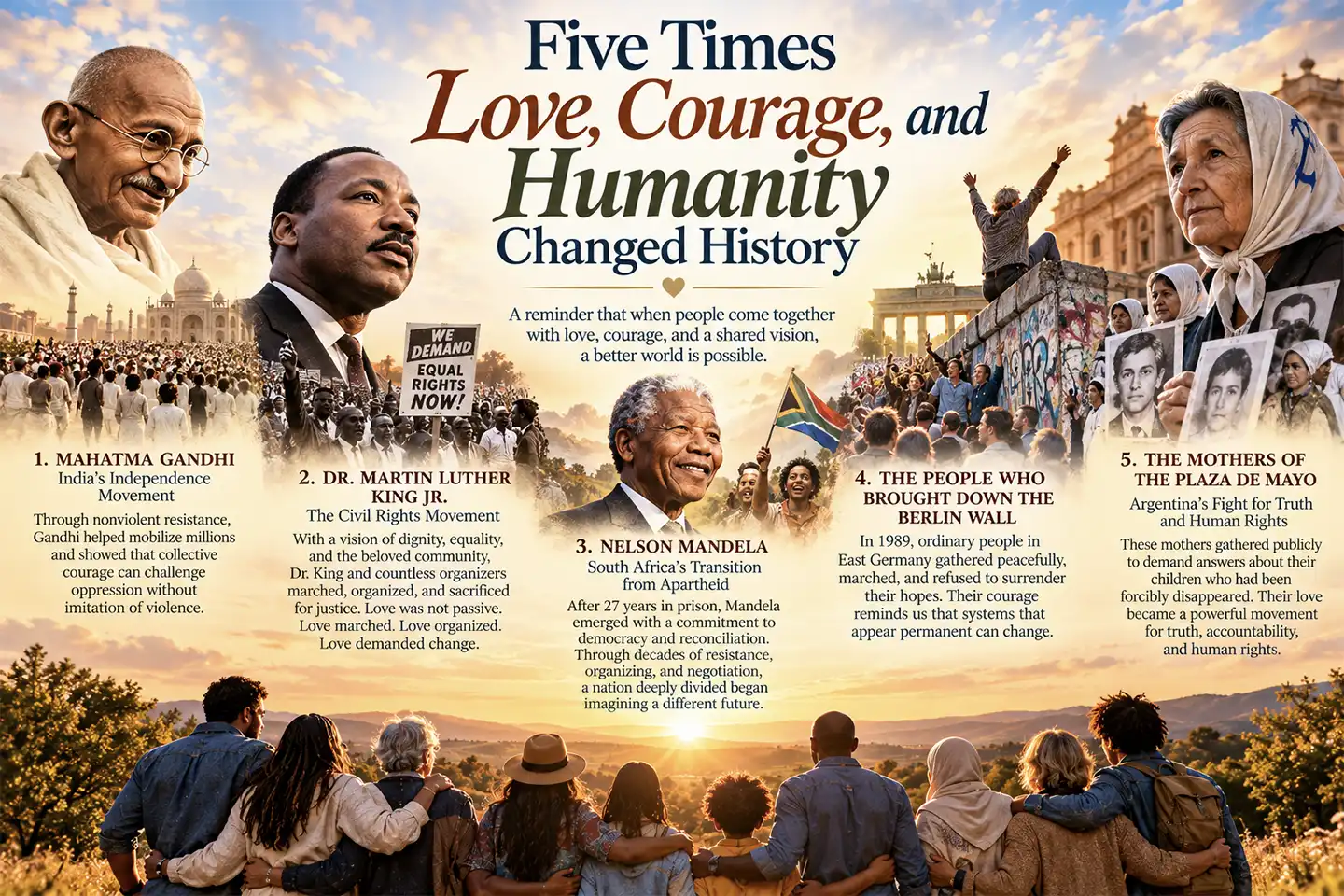
1. Mahatma Gandhi and India’s Independence Movement
Gandhi helped mobilize millions through nonviolent resistance to British colonial rule. His approach demonstrated that collective courage and disciplined noncooperation could challenge a powerful empire. India’s independence in 1947 was the result of many movements, leaders, and sacrifices, and the period also involved devastating communal violence. Still, the nonviolent movement left an enduring lesson: People do not have to imitate the violence of those in power to challenge injustice.
2. Dr. Martin Luther King Jr. and the Civil Rights Movement
Dr. King and countless civil rights organizers faced hatred, intimidation, imprisonment, and violence. They organized around a vision of dignity, equality, justice, and what King called the beloved community. Through boycotts, marches, legal challenges, and sustained community action, the movement helped secure landmark civil rights legislation. Love was not passive. Love marched. Love organized. Love sacrificed. Love demanded change.
3. Nelson Mandela and South Africa’s Transition from Apartheid
After 27 years in prison, Nelson Mandela emerged with a commitment to building a democratic South Africa. The end of apartheid was achieved through decades of resistance, organizing, international pressure, and difficult negotiations. Mandela’s emphasis on reconciliation helped create space for a country deeply wounded by institutionalized racial oppression to begin imagining a different future. Reconciliation did not erase injustice or its consequences. But it offered a path beyond endless retaliation.
4. The People Who Brought Down the Berlin Wall
In 1989, peaceful demonstrations in East Germany grew into a movement demanding freedom and political change. Thousands of ordinary people gathered, marched, and refused to surrender their hopes for a different future. The Berlin Wall opened in November of that year, becoming a powerful symbol of the collapse of an oppressive division. Their courage reminds us that systems that appear permanent can change.
5. The Mothers of the Plaza de Mayo in Argentina
During Argentina’s military dictatorship, mothers began gathering publicly to demand answers about their children who had been forcibly disappeared. They faced intimidation and danger, yet continued their advocacy. Their love for their children became a sustained movement for truth, accountability, and human rights.What began with mothers refusing to be silent grew into a moral witness recognized around the world.
These stories do not mean that love always wins quickly, or that suffering disappears.
They remind us that love can become a force for change when it is joined with courage, persistence, solidarity, and action. And that matters enormously in this moment.
Three Ways to Protect Your Hope, Joy, and Love
We cannot control what happens in the world. We cannot determine every election outcome, stop every conflict, or change every decision made by those in positions of authority. But we can cultivate our inner landscape. We can choose how we engage, how we respond, and what we contribute to the collective.
1. Protect Your Inner Environment
- Pay attention to what you are allowing into your consciousness.
- Being informed does not require being inundated.
- You can care deeply about the world without consuming every disturbing headline, every argument, and every political message.
- Give yourself permission to step away from the noise.
- Take a walk. Meditate. Breathe. Listen to music. Spend time in nature. Connect with someone you love.
Ask yourself:
Is what I am consuming helping me become more conscious, compassionate, and effective, or is it keeping me in a state of fear and reactivity?
Your peace deserves protection.
2. Practice Love as an Action, Not Just a Feeling
Love is more than a beautiful spiritual concept. Love is something we practice.
- It is how we speak to people with whom we disagree.
- It is how we care for our neighbors.
- It is how we show up for someone who is struggling.
- It is how we listen without immediately judging, and how we advocate for dignity without surrendering our own humanity.
Choose one loving action every day. Reach out to someone who feels alone. Support a community organization. Help someone meet a basic need. Offer encouragement. Engage in a meaningful conversation.
Small acts of love do not replace the need for systemic change, but they strengthen the human connections that make lasting change possible.
3. Remember Your Power to Choose Your Inner State
In my work with Emotional Integration™, I remind people that our emotions are not enemies. They are messengers. Fear, anger, grief, and disappointment are understandable responses to what we are witnessing. We do not have to deny these feelings or pretend that everything is wonderful. We can acknowledge them, explore what they are telling us, and consciously choose how we want to respond.
Pause and ask:
- What am I feeling?
- What is this emotion asking me to understand?
- What response would honor my values and contribute to the world I want to live in?
This is where personal transformation becomes collective transformation. When we learn to respond rather than react, we become more capable of creating the peace, connection, and understanding we desire.
We Are Not Forsaken
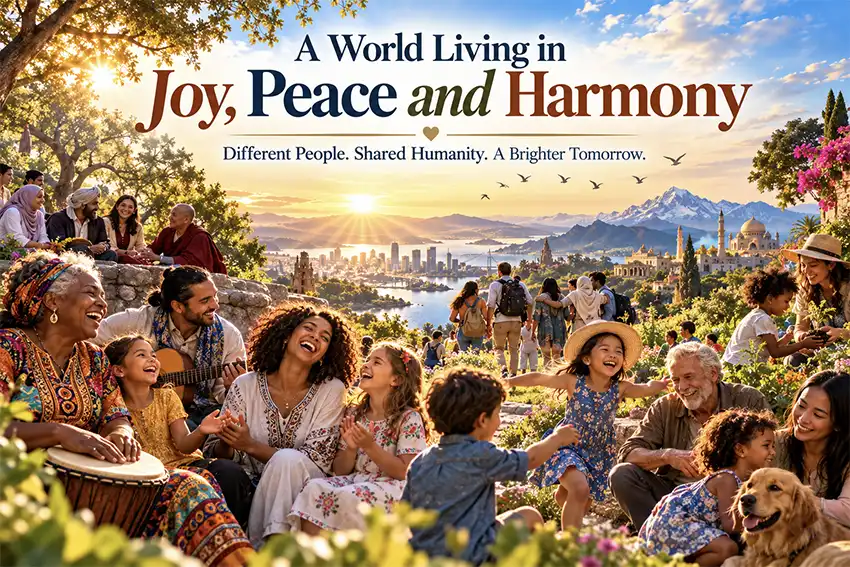
I want to leave you with something I believe deeply. Peace and harmony live within us. We came encoded with these amazing gifts. They may sometimes be buried beneath fear, disappointment, grief, or the relentless demands of life, but they have not disappeared.
We are not forsaken. We are not powerless. And we are not alone. There is a presence, an intelligence, a universal love that I believe continues to support us, even when the outer world seems chaotic.
Some call it God. Some call it Spirit, Source, Higher Power, Divine Intelligence, or the Universe. Whatever language you use, I invite you to remember that you are connected to something greater than the circumstances of this moment. Hope is not pretending everything is okay. Joy is not ignoring suffering. And love is not weakness.
Hope is the courage to envision something better. Joy is our capacity to remain connected to life, even in difficult times. Love is the conscious choice to honor our shared humanity.
So, as elections unfold, as headlines change, and as the world continues to navigate uncertainty, I invite you to ask:
- What kind of world am I helping to create?
- Am I feeding fear or nurturing possibility?
- Am I contributing to separation or strengthening connection?
- How can I become a greater expression of the love I want to see in the world?
We have more power than we sometimes remember. And I still believe that humanity has the capacity to create a world where safety, dignity, health, well-being, and prosperity are not privileges reserved for a few, but possibilities available to all.
Call me optimistic. I call it remembering who we truly are. Join my community to be with likeminded people.
Love has changed the world before. And love, expressed through conscious action, can change it again. The Universe has our back.
With love and blessings,
Cynthia James